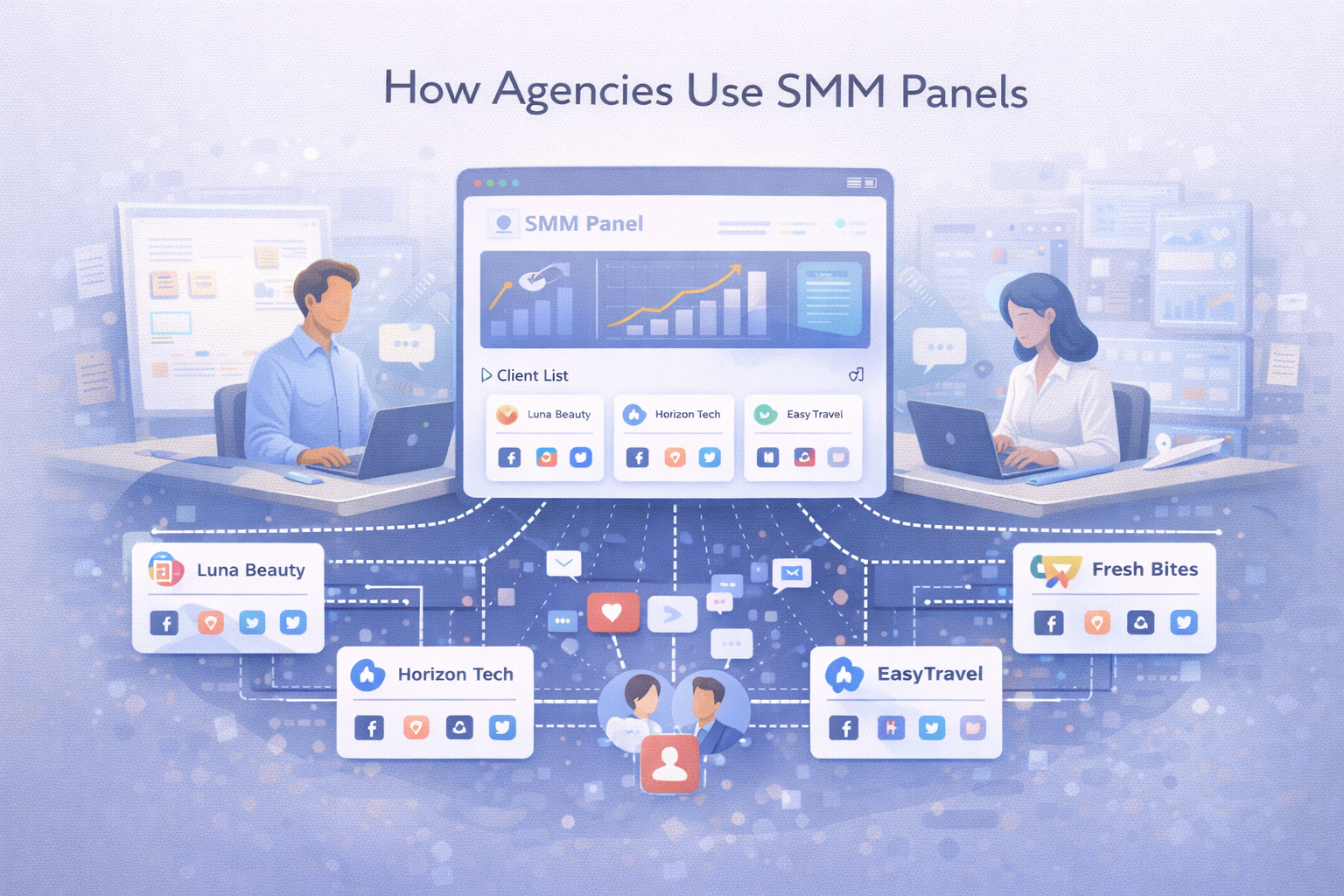
How Agencies Use SMM Panels to Manage Multiple Clients (And Scale Profit)
Let's be direct.
Most social media agencies aren't doing what you think they're doing. The polished decks, the "strategy calls," the monthly reports showing steady follower growth — a significant chunk of that machinery runs on one thing: a professional smm panel That's not a criticism. It's how the industry actually operates. And if you're an agency owner, a brand manager, or even a curious freelancer trying to understand how competitors are scaling so fast — this is the post you need to read.
| The Pressure Agencies Face Is Real
Every agency has the same problem. Clients want results. Not in six months. Now.
Organic growth is slow, algorithm-dependent, and wildly inconsistent. One platform update can tank three months of content strategy overnight. Clients don't care about that. They signed a contract. They want their numbers moving. That gap — between what clients expect and what organic growth delivers — is exactly where SMM panels fill in. They're not a shortcut. For agencies operating at scale, they're infrastructure.
| The Wholesale Model: Where the Real Margin Is
Here's the business model most agencies don't talk about publicly.
A client pays $500–$1,000 per month for "Social Media Management." Inside that package, the agency handles content, posting schedules, engagement strategy — and growth metrics. What the client sees is a clean dashboard and improving numbers. What happens behind the scenes is a different story.
The agency logs into their panel, sources 10,000 views for roughly $1, bundles it into a "Premium Visibility Package," and invoices the client $100 for that line item alone.
That's a 9,900% markup.
Multiply that across 20 clients and you're not running a service business anymore. You're running a margin machine. The wholesale pricing that professional panels offer is what makes the entire agency model financially sustainable — especially when you factor in creative team salaries, ad budgets, and software subscriptions.
This is why experienced agency owners prioritize panel access the same way they prioritize their CRM or project management tools. It's core ops.
| White-Label Panels: Selling the SaaS Experience
Here's where it gets more sophisticated.
Large agencies — the ones managing enterprise clients or running multiple sub-brands — don't just use a panel. They run their own. It's called a Child Panel, and it's one of the most powerful setups in the industry. A Child Panel lets the agency create a completely branded storefront. Clients log in, see their growth stats, track their orders, and experience what feels like a proprietary SaaS platform. The agency's name is on everything. The underlying provider is invisible.
Why does this matter? Two reasons.
First, it protects the margin. Clients have no idea what the wholesale cost is. They see a polished interface, not a price list.
Second, it increases perceived value. When a client logs into a custom dashboard that looks like enterprise software, they feel like they're paying for something premium. Churn drops. Upsells become easier. The relationship feels stickier.
This is exactly how mid-size agencies punch above their weight and compete with agencies three times their size. The infrastructure does the heavy lifting.
| Burst Fulfillment: The On-Demand Growth Layer
Not everything in social media is predictable. Clients throw curveballs constantly.
A product launch moves up two weeks. A client decides to host a live webinar on 72 hours notice and wants it to look like a packed event. A flash sale goes live at midnight and the brand needs visibility within the first 30 minutes.
This is where real-time API delivery becomes critical.
A professional panel's API lets the agency trigger delivery the exact moment an event goes live. Need 500 live viewers on a webinar to signal high demand and social proof? Done — starting at the scheduled time, not five hours after when it no longer matters.
Without this capability, an agency either overpromises and underdelivers, or turns down the client's request entirely. Neither is a good outcome. The panel makes on-demand growth possible at a level that no organic strategy can replicate on short timelines.
For event-driven campaigns, product launches, and anything tied to a specific date and time, this is non-negotiable infrastructure.
| SLA Management: How Agencies Never Miss a Target
Most agencies worth their retainer fees offer some version of a growth guarantee. A certain number of followers per month. Minimum engagement rates. Reach benchmarks. These commitments end up in contracts, and missing them triggers conversations nobody wants to have.
The problem is that platforms don't cooperate. Algorithm shifts, reduced organic reach, content format changes — any of these can flatline growth for weeks.
Smart agencies don't panic. They "top up."
When organic performance dips, the panel fills the gap. The monthly numbers stay on track. The client sees consistent results. The agency keeps the account. No awkward explanations. No renegotiations.
This isn't about deceiving clients — it's about maintaining service consistency in an environment that's inherently unpredictable. The panel acts as a buffer between what the algorithm gives and what the contract requires.
| Why This Model Scales and Organic-Only Doesn't
Think about what it takes to deliver results for 30 clients using only organic methods. You need content creators, platform specialists, community managers, data analysts — and even then, you're at the mercy of trends and algorithms.
Now think about what it takes when you layer in panel access. You retain the creative team for high-value work. You use the panel to maintain baseline growth and fulfill burst requests. You protect your margins with wholesale pricing. You run a child panel to deliver a premium client experience.
The agencies growing fastest right now aren't working harder. They're building smarter infrastructure.
If you're running a social media agency and you're not leveraging a professional panel, you're leaving serious money on the table and working twice as hard to deliver half the results.
The panel isn't the product. Your strategy, your relationships, and your positioning are the product. The panel is the engine that makes delivery consistent, scalable, and profitable.
Build the infrastructure. Protect your margins. Scale with control.
That's how serious agencies operate.