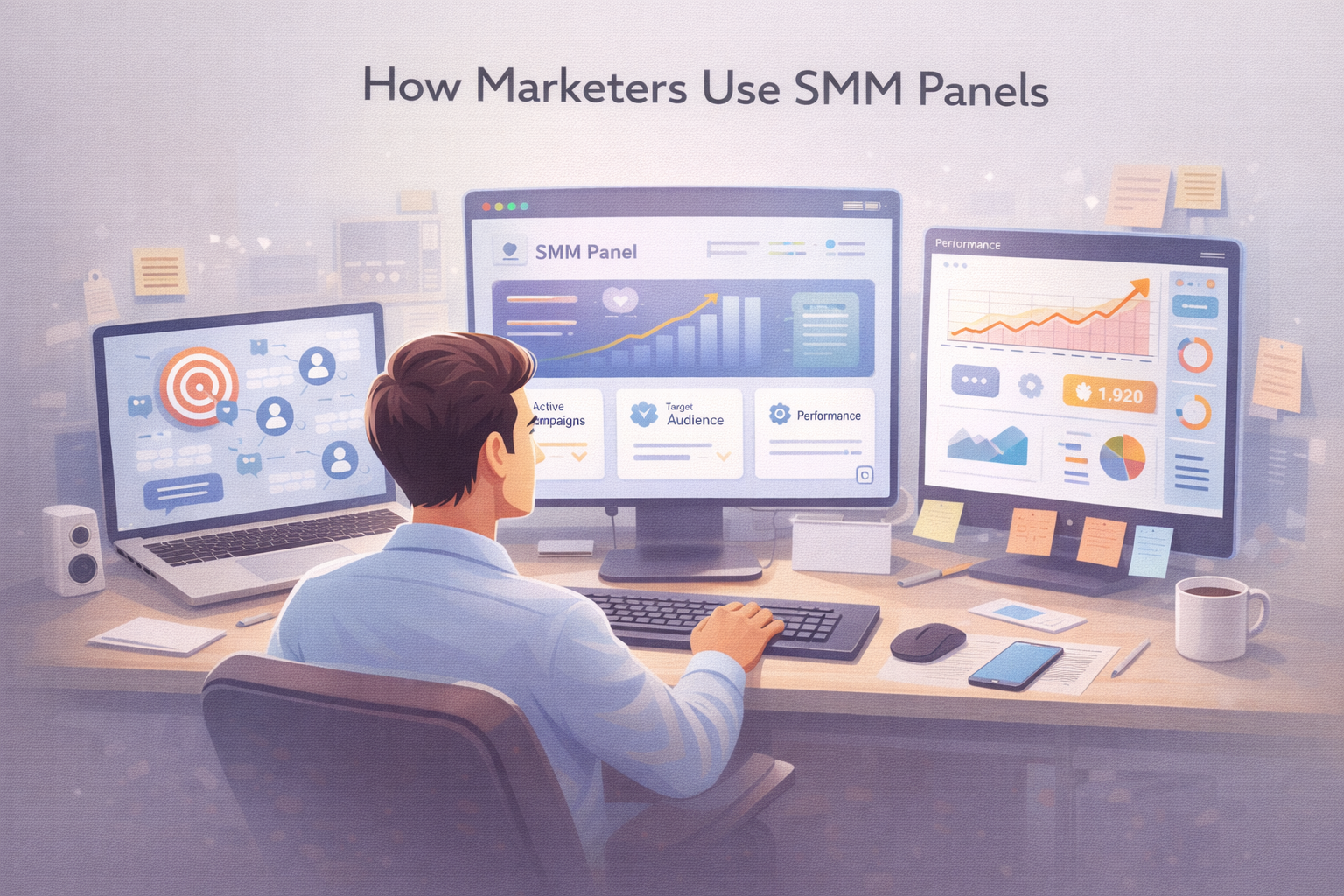
How Marketers Use: SMM Panels to Scale Campaigns
10 min read • Strategy & Execution • Updated April 2026
Digital Marketing | Social Media | Growth Strategy
Modern digital marketing is a game of optics. You can have the best product in the world — but if your Instagram page looks like a ghost town, your conversion rate will suffer. Professional marketers don't use SMM panels to "fake" success. They use them to engineer it.
There's a version of this story that sounds shady. And there's the real version — the one happening inside actual growth teams at funded startups, e-commerce brands, and agency war rooms every single day. This is the real version. Here's exactly how top-tier marketers integrate an smm panel into their daily workflows — and why the results speak for themselves.
Strategy 01
Building initial trust for new launches
When a marketer launches a new brand, they walk straight into what I call the Zero-Follower Curse. Potential customers are hesitant — sometimes completely unwilling — to buy from a page with no social history. No followers. No engagement. No proof of life.
It doesn't matter how good the product is. The page looks untrustworthy. And in a world where buying decisions happen in under eight seconds, "untrustworthy" is a death sentence.
The marketer's move
Use an SMM panel to establish a baseline authority — typically 2,000+ followers and consistent post engagement before the first paid dollar is spent. This lowers the barrier to entry for organic users, making them significantly more likely to trust the brand, engage with content, and convert into paying customers.
Think of it as staging a house before selling it. You're not lying about the property. You're presenting it in its best possible light so that the right buyer can actually see the value.
Strategy 02
Lowering ad costs before you even go live
Facebook and Instagram ads are expensive — and getting more expensive every quarter. But here's something most brand managers don't know: the social proof already on a post directly affects how cheap or costly your ad traffic becomes.
When an ad post already has thousands of likes and a healthy comment section, the algorithm interprets it as high-quality content. That lowers your cost-per-click. It raises your click-through rate. And it compresses your cost-per-acquisition across the entire campaign.
The strategy
Before flipping on a $500/day ad campaign, prime the post with 500+ likes and 20+ authentic-looking comments via an SMM panel. You're not gaming the algorithm — you're giving it the signal it needs to reward your content with cheaper distribution. The savings compound over weeks and months of running ads.
One client I worked with dropped their CPC by 34% simply by priming their ad creative before launch. That's not a rounding error — that's a material reduction in CAC on a six-figure ad budget.
Strategy 03
Reputation management and crisis control
No brand goes unscathed forever. A competitor with a coordinated troll squad. A bad batch. A comment section that got away from the social team on a Friday afternoon. These things happen — and when they do, response time is everything.
The instinct is usually to delete negative comments. That's almost always the wrong move. Deletion signals guilt. It invites screenshots. It creates a story where there wasn't one.
The strategy
Use custom comment services to push positive, helpful, and constructive responses to the top of the feed. Dilute the negativity without removing it. The goal isn't suppression — it's proportion. One bad comment in a sea of 50 engaged, positive responses carries no weight. Let the math work for you.
This is exactly how brand PR teams at scale handle it. You're not silencing critics. You're making sure a small coordinated attack doesn't define the entire brand perception for every new visitor who lands on the page.
Strategy 04
Strategic multi-platform presence without the chaos
Here's the operational reality most solo founders and lean teams run into: you need authority on X (Twitter), LinkedIn, Instagram, Telegram, and YouTube — often simultaneously. Building organic traction on five platforms at once, each with its own algorithm, is a full-time job.
It's not scalable. And it pulls creative energy away from the work that actually compounds — content, offers, and relationships.
The efficiency play
Use a single SMM panel dashboard to maintain the baseline pulse across all brand channels while your team focuses on high-leverage content production. Set the floor. Then let content do the heavy lifting above it. You're not automating your brand — you're automating the grunt work so your brand team can focus on what matters.
Brands that show up consistently across platforms — even at a modest but credible scale — close more deals, attract better partnership opportunities, and build media presence faster than those siloed to a single channel.
Expert insight
The 30/70 marketing rule — and why it matters
Every marketer serious about sustainable growth follows this ratio religiously. It's not a suggestion — it's a strategic constraint.
30% boosted growth - 70% organic content
The panel gives your content the stage it deserves. But the content still has to earn its seat. Use the panel to amplify great work — not to substitute for it. The moment you flip that ratio, you've built a house of cards. Engagement without substance doesn't convert. It just looks good in a vanity dashboard until the next platform algorithm update wipes it out.
Brands that win long-term are the ones using boosted signals to get their organic content in front of more people, then letting that content do the actual selling. The panel is the launcher. Your content is the rocket.
Social proof is infrastructure. Not decoration. It's the thing that makes every other part of your funnel — your ads, your outreach, your landing pages — perform closer to its theoretical ceiling.
SMM panels are a tool. Like any tool, the result depends entirely on how you use it. In the hands of a growth marketer with a real content strategy and a clear conversion goal, they're a force multiplier. Without that foundation, they're noise.
The marketers winning right now aren't ignoring these tools because they sound sketchy. They're using them intelligently — as one lever in a larger system designed to build real authority, real trust, and real revenue.
That's the play. Build the foundation. Prime the launch. Let the content run.
Ready to stop building from zero every time you launch?
The right SMM panel doesn't replace your marketing strategy — it accelerates it. Use it as the infrastructure your content deserves, and watch your cost-per-acquisition drop while your organic authority grows.