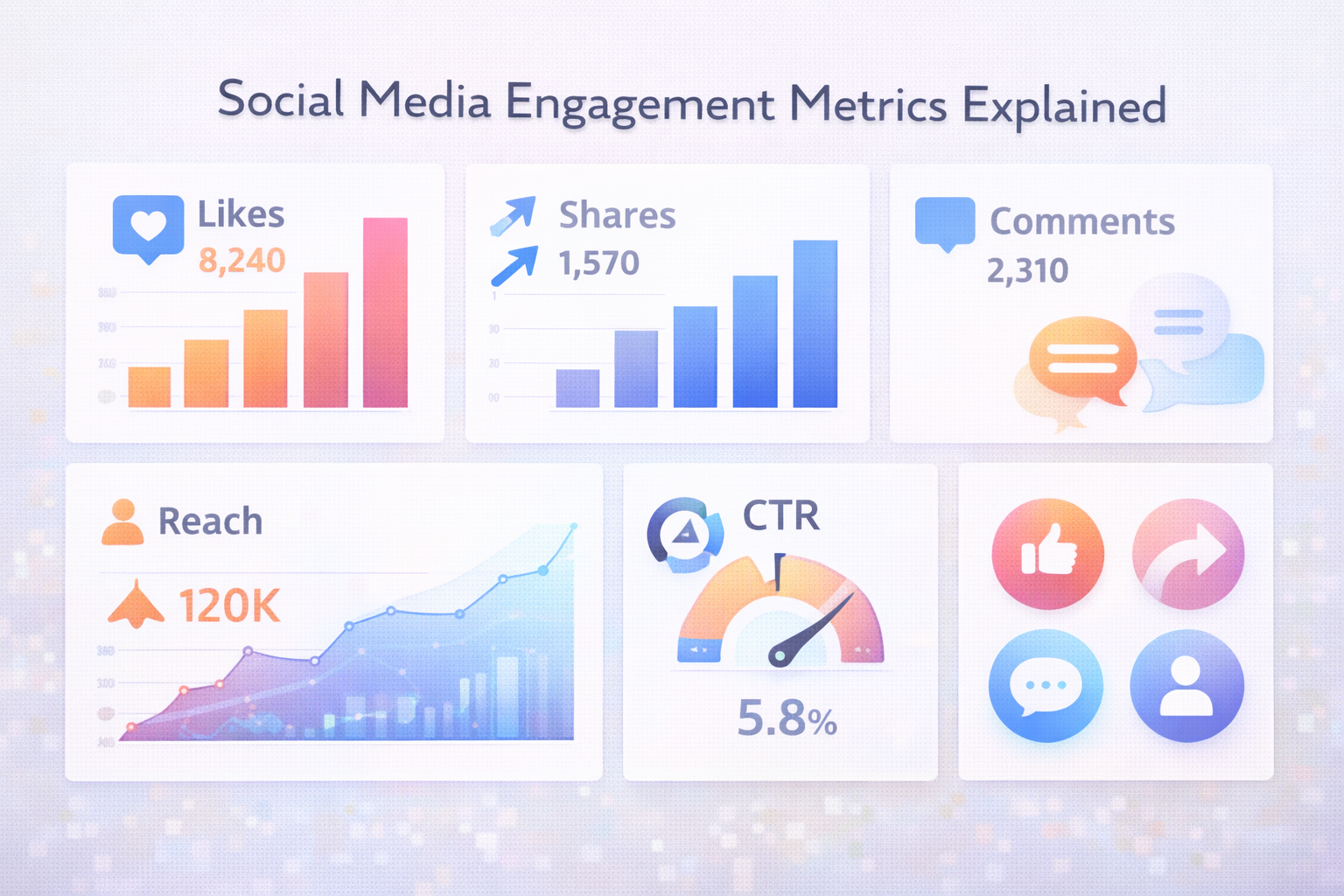
Social Media Engagement Metrics Explained (With Benchmarks)
8 min read | Updated April 2026 | For brands, founders & growth teams
Confused by reach vs impressions or saves vs shares? We break down every social media engagement metric with platform benchmarks so you can actually report results that make sense.
Here's the uncomfortable truth: you've been measuring the wrong things.
You've run a campaign. The client asks, "So how did we do?"
You pull up the dashboard — and suddenly you're staring at 14 different numbers. Reach. Impressions. Engagement rate. Saves. Story exits. And you're not 100% sure which ones actually matter.
This guide cuts through the noise. We explain every major social media engagement metric, what it actually measures, and what a good number looks like in 2026.
What is engagement rate — and why it's the only metric that matters
Reach and SMM Panel follower count tell you how big your audience is. Engagement rate tells you whether they care.
The formula is simple:
Engagement Rate = (Total Engagements ÷ Total Reach) × 100
A post with 10,000 impressions and 300 likes, comments, and shares has a 3% engagement rate. Whether that's good or bad depends entirely on the platform.
2026 benchmarks by platform:
Platform Average engagement rate Strong engagement rateInstagram (feed posts)1.5% – 3%Above 5%Instagram Reels3% – 6%Above 8%Facebook pages0.5% – 1%Above 2%YouTube (likes/views)2% – 4%Above 6%LinkedIn2% – 4%Above 5%
Reach vs Impressions — the most confused metric pair
These two get mixed up constantly.
Reach = the number of unique accounts that saw your content. Impressions = the total number of times your content was displayed, including repeat views by the same person.
If your post has 800 reach and 1,200 impressions, that means on average each person saw it 1.5 times. A high impressions-to-reach ratio means your content is being shown repeatedly — which is usually good because it means the platform's algorithm keeps serving it.
Saves: the most underrated metric on Instagram
Saves signal that someone found your content valuable enough to return to. Instagram's algorithm treats saves as a high-quality engagement signal — much stronger than a like.
If your Reels or carousel posts get consistent saves, that's a strong sign the content will be pushed to the Explore page.
What to track: Save rate = (Saves ÷ Reach) × 100. Anything above 1% on a feed post is solid.
Comments vs Shares — which matters more?
Shares distribute your content to new audiences. They're the engine of organic reach growth. Comments signal community — they tell the algorithm that your content starts conversations.
For brand-building: prioritise comments. For reach expansion: prioritise shares.
Story-specific metrics: exits and taps forward
Most people ignore these, but they reveal your story's quality.
- Taps forward = someone skipped your story slide. High taps forward on slide 2 means slide 1 didn't hook them.
- Exits = someone left your story entirely. A spike on a specific slide is a red flag — that slide probably broke the momentum.
- Story completion rate = the % of viewers who watched all the way through. Above 70% is strong.
Video-specific: watch time and retention
For YouTube and Instagram Reels, average watch time is the single most important metric. Platforms reward content that keeps people watching.
On YouTube: getting past the 30% mark means the algorithm considers it a "qualified view." Getting past 50% is excellent.
On Reels: a completion rate above 60% pushes the video to wider distribution.
How to use SMMGalaxy to boost your engagement metrics
Low engagement rate often comes from a cold start — your content is good, but the algorithm hasn't seen enough initial signal to distribute it.
SMMGalaxy's engagement services give your posts the early traction they need. A post that gets 100 saves and 50 comments in the first hour performs very differently in the algorithm than one with zero activity — even if the organic quality is the same.
Start with our Instagram engagement packages to give your content the push it needs to reach real audiences.