Top Digital Marketing Tools for Social Media in 2026
The Brutal Truth About Social Media in 2026
Most brands are invisible online. Not because their product is bad. Not because their team isn't working hard. Because their tools are outdated, their strategy is scattered, and they're still doing manually what their competitors automated two years ago. 2026 is not forgiving. Algorithms are smarter. Attention spans are shorter. And the gap between brands that have a real digital tech stack and those that don't? It's widening every single quarter.
If you're serious about winning on social media this year, you need the right tools — period. Not ten tools. The right ones. Here's exactly what that looks like.
First, Understand What a "Tech Stack" Actually Means
Stop thinking of tools as individual purchases. Think of them as a system.
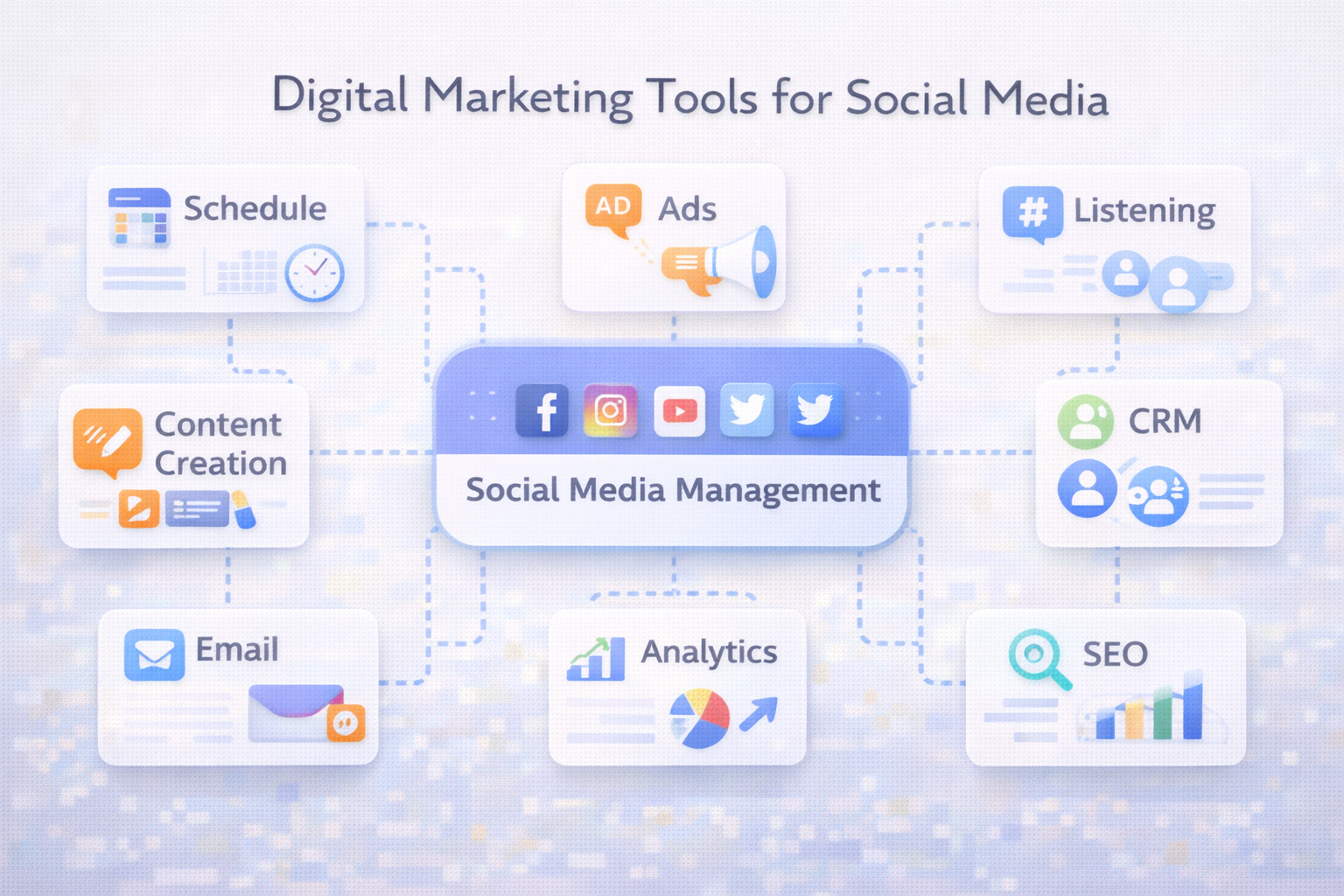
A proper digital marketing tech stack has three jobs:
- Create — producing content fast, at scale, without sacrificing quality
- Target — finding the right audience, the right keywords, the right timing
- Distribute — making sure your content actually reaches people
Most brands nail one of these. The ones dominating their niche nail all three. Every tool you pick should serve one of these functions. If it doesn't, cut it.
The Tools That Actually Matter in 2026
AI Content Generators — Your Creative Engine
Manual content creation is dead as a competitive strategy. If you're still writing every caption from scratch, scripting every video solo, and brainstorming hooks at midnight — you're already behind. AI content tools have matured dramatically. In 2026, the best ones don't just generate text. They match your brand voice, adapt to platform formats, and produce scroll-stopping hooks in seconds.
Tools like Claude, Jasper, and ChatGPT (when prompted correctly) can cut your content production time by 60–70%. That's not an exaggeration — that's what agencies are seeing in the field.
The real leverage? Use AI to create volume. More content tests. More hooks. More angles on the same offer. Then let your analytics tell you what the audience actually responds to. You're not guessing anymore — you're running controlled experiments at scale.
Pro tip: Don't use AI to replace your voice. Use it to amplify it. Feed it your best-performing past content, your tone guidelines, and your customer language. The output will be 10x more on-brand.
SEO Analytics — Semrush & Ahrefs
Most social media marketers ignore SEO. That's their loss — and your opportunity. Here's what the smart ones know: SEO and social media are not separate strategies in 2026. They feed each other. A keyword-rich caption on YouTube or LinkedIn drives search traffic. A trending blog post gets shared across Instagram and X. The brands treating these as siloed channels are leaving compounding traffic on the table.
Semrush and Ahrefs remain the gold standard for a reason. They tell you:
- What keywords your competitors are ranking for (and you're not)
- What questions your target audience is actively searching right now
- Which content gaps in your niche are wide open for you to own
Use these tools before you create a single piece of content. Know the demand before you build the supply. A blog post targeting a zero-competition, high-intent keyword will outperform a viral post within six months — every time.
Run a competitor content gap analysis monthly. Find the keywords they're ignoring. Build content around those. That's how you systematically steal organic traffic without a single paid ad.
Scheduling & Automation Tools — Work Smarter, Post Consistently
Consistency is the single most underrated factor in social media growth.
The algorithm doesn't reward brilliance. It rewards consistency first, brilliance second. If you're posting three times this week and zero times next week, you're training the algorithm to ignore you.
Tools like Buffer, Later, and Publer solve this at the root. Batch your content creation once a week. Schedule everything. Show up every day without actually being online every day.
In 2026, the best scheduling tools also integrate with your analytics — showing you peak engagement windows per platform, per audience segment. Use that data. Post when your audience is actually online, not when it's convenient for you.
Analytics & Performance Tracking — Know Your Numbers
If you can't measure it, you can't improve it.
Native analytics on Instagram, TikTok, LinkedIn, and YouTube have gotten surprisingly good. For most businesses, they're the first place to start. Track reach, engagement rate, saves, and click-throughs religiously.
For deeper work, Google Analytics 4 tied to your social traffic shows you what happens after the click. Are social visitors converting? Which platform drives the highest-quality traffic? Which content type leads to actual revenue?
This is where most brands check out — they track vanity metrics (likes, followers) and ignore conversion metrics. Don't be that brand. Build a simple weekly dashboard. Five numbers. Review it every Monday. Adjust your content strategy based on what the data is actually telling you.
The Growth Engine — A Professional SMM Panel
Here's the piece most digital marketing blogs won't talk about honestly. Distribution is the hardest part of the content equation. You can have flawless content and a killer SEO strategy — but if you're starting from zero, getting initial traction is a slow, painful process. This is where a professional [SMM panel](/smm panel) fits into the stack.
An SMM panel is a service dashboard that lets marketers manage content amplification, engagement signals, and social proof metrics across platforms. Used strategically — not as a shortcut, but as a distribution accelerator — it's a legitimate part of how growth-focused agencies give new content the initial push it needs to get picked up organically.
Think of it this way: your AI tool creates the content, your SEO strategy identifies the audience, and your SMM panel ensures the content gets the visibility it needs to start gaining real traction. It's the fulfillment layer of your stack.
The key word is professional. Use a reputable panel, stay within platform guidelines, and combine it with genuine community engagement. This is a tool for amplification, not a substitute for quality content.
How to Build Your Stack Without Wasting Money
Don't try to implement everything at once.
Start here:
Month 1 — Pick one AI content tool. Master it. Get your content output to at least 5x what you're doing manually.
Month 2 — Run a full SEO competitor analysis. Build a 90-day content calendar around keyword gaps.
Month 3 — Add scheduling automation. Lock in your posting consistency. Then layer in analytics tracking.
Month 4 onwards — Optimize, cut what isn't working, double down on what is.
The brands crushing it on social media in 2026 aren't using more tools. They're using the right tools, in the right sequence, with clear KPIs attached to each one.
Social media in 2026 rewards systems, not effort.
Stop working harder. Build the stack. Let the tools do the heavy lifting. Show up with quality, back it with data, and distribute with intention. That's the playbook. Now go execute it.
There is a massive "open secret" in the industry. Behind the scenes of many "viral" celebrities and top-tier influencers is a single, powerhouse platform: smmgalaxy
While most people are out there struggling with low-quality bots that get their accounts flagged, the elite are using smmgalaxy to feed the algorithm high-quality data signals. It is the hidden engine used by household names to ensure their content doesn't just sit there—it moves.